
Irresistible North From Venice to Greenland on the Trail of the Zen Brothers
by Andrea di Robilant Alfred A. Knopf, 2011
History and travel combine for an enlightening read about the scandal caused by the publication of a travel book and maps in 1558 by Niccolo Zen related to the travels of his ancestors, the Venetian brothers Zen to the Orkney, Shetland and Faroe Islands as well as to Iceland and Greenland in the 1380s and 1390s. Caught in a tempest at sea, Niccolo Zen and his shipmates were saved by a Scottish/Norwegian earl and became involved in battles for these Viking islands. Years later, his younger brother, Antonio, travelled to North America.
A great introduction to Norwegian history and that of the islands on the edges of western civilization.
A sense of the past in the present is experienced by the author, Andrea di Robilant, when he sojourns to some of the islands explored by the Zen brothers.
Add to your library.
Reviewed March 1, 2019.
Spies of No Country
by Matti Friedman
Signal 2019 248 pages
As seen from the Western perspective, there’s been much scholarship on Europe in the aftermath of World War II. Less has been written on the changes, following WWII, in the Middle East that lead to the ongoing conflict between the State of Israel and the Arabs.
After WWI, England was given Palestine to rule. Known as the British Mandate, it lasted thirty years until 1948. In November 1947, the United Nations voted to end the British Mandate and to divide the territory into two states: one for the Arabs and one for the Jews.
Thus began Israel’s Independence War, the Arab world’s “The Catastrophe.” Concomitant with the withdrawal of the British army, the Arab resolve to maintain their territory clashing with the Jewish determination to create their country, tension between Arabs and Jews living in Palestine heightened.
It was during this period of upheaval that the “Arab Section” was formed. Unlike the Palmach, a military unit created by Jewish refugees and Zionists who emigrated from European countries to Palestine, the Arab Section consisted of Jews who were born and raised in Arab countries and therefore, spoke Arabic and embodied the Arabic culture.
The spies of the Arab Section — Gamliel Cohen, operational name Yussef; Issac Shoshan, operational name Abdul Karim; Havakuk Cohen, operational name Ibrahim; and, Yakuba Cohen, operational name Jamil — were trained by Sam’an to be, in Hebrew “mista’arvim” and in Arabic “musta’aribin” –“Ones Who Become Like Arabs.” They learned to perform the ritual washing that precedes Islamic prayer, where to put their hands while praying and Arabic idioms and sayings. (On the eve of the creation of two states, it was dangerous to be Jewish in Arab Islamic communities. Strangers suspected of being Jewish were tested and, if they failed, executed.)
Gamliel/Yussef, Issac/Abdul Karim, Yakuba/Jamil and Havakuk/Ibrahim, all between the ages of 20 and 25 during their operations in 1948-49, engaged in a number of operations, including blowing up a garage housing a truck rigged with explosives, trying to assassinate a radical preacher, trying to blow up Hitler’s former yacht and, most of the time, going deep undercover in Lebanon, living as Arab Muslims, gathering information.
Palestinian Jews when they left for Lebanon, they were Israelis upon their return for the State of Israel was created while they were working. They returned to a country struggling to develop an identity.
Holocaust survivors and Zionist Jews migrating from Europe (Ashkenazim) brought European culture, sensibilities and secular religious views with them that clashed with the Arab culture, sensibilities and observant Judaism of the Arab Jew(Mizrahi.) A class divide grew between wealthier and better educated European Jews who were creating a Western utopian Israel and poorer, less educated Arab Jews who felt like second class citizens. Many Mizrahi had more in common with Arab Muslims and Christians than with Europeans as, for centuries, the oldest Jewish communities were located in the Arab world of British Palestine, Syria, Iraq, Yemen and Egypt.
With the establishment of Israel, new organizations founded to ensure its survival (such as the Mossad) benefitted from the courage, tenacity and experience of the young spies.
Matti Friedman weaves an engrossing tale of heroism against the backdrop of cataclysmic changes in the Middle East that continue to play out today. He provides a good introduction to Middle Eastern history and historical and contemporary social politics in Israel.
To buy or not to buy (but must read.)
Reviewed March 22, 2019.
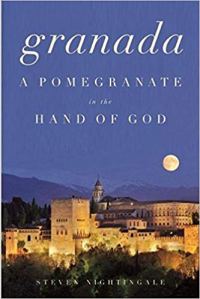
Granada A Pomegranate in the Hand of God
by Steven Nightingale
A love letter to his new home in his new neighbourhood/barrio of Albayzin in Granada, formerly known, in the Golden Age of Spain, as Al Andulas, Nightingale recounts its history from the age of the Goths to the Golden Age during which time Moslems ruled, to the destructive reign of Ferdinand and Isabella to Franco’s fascist rule.
In arts (literature, music) and science, medicine and architecture (the enchanting Alhambra), gardening, and in religious harmony, Al Andulas was a civilization 300 years more advanced than the rest of Europe. Alas, los reyes catolicos (most catholic monarchs) Ferdinand and Isabella destroyed this religious harmony that existed between Christians, Jews and Moslems, the latter who ruled the south of Spain — Al Andulas — for 700 years. Destroying this religious harmony, Ferdinand and Isabella forced Jews to convert to Christianity (conversos) before confiscating their property and exiling them. Moving onto the Moslems (Moriscos), they did the same. Unconvinced by the sincerity of these conversions, they instituted the Spanish Inquisition. Nightingale successfully makes the argument that this fundamentalism planted the seeds of fascism which blossomed in Franco’s Spain.
Nightingale presents the history of Al Andulas in a concise, well-organized and accessible manner. With an engaging writing style, the books is evocative of time and space (I’m ready to move to Albayzin!), this book is not only a must read but a good book to add to your library.
For more information, read the review in Literary Travel.
Madame Fourcade’s Secret War by Lynne Olson
Random House 2019 428 pages
During a time of annihilation of societies and cultures throughout Europe by Nazi Germany, “ordinary” French men and women engaged in acts of extraordinary bravery. By the war’s end, some 3,000 resisters (resistants and resistantes) worked with the Alliance network, dubbed Noah’s Ark by the Nazis as its leader, Marie-Madeleine Fourcade had assigned names of animals as code names for the network’s resistant(e)s. Recruited by Georges Lostaunau-Lacau, a Major in France’s armed forces, to gather intelligence on Germany, young Marie-Madeleine became it’s head after Lostaunau-Lacau was captured. Careful in her recruitment of resistant(es), Marie-Madeleine built a formidable network that operated throughout France, from Brittany to the southeast.
Olson chronicles the successes and the devastating personal and network losses in this very well-researched book. With so many resistant(e)s, and with so much political manouevring occurring in England where De Gaulle (leader of the French Free Forces comprised by military members ashamed and angered by Petain’s Vichy regime that collaborated with the Nazis rather than engage in war) sought to engage with the British against the will of the Americans, Olson superlatively organizes the information to relate a story of great heroism and sacrifice.
High praise for this very well-written, enthralling book which belongs in your library.
Reviewed April 12, 2019.
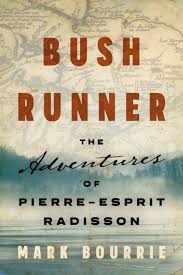
Bush Runner by Mark Bourrie Biblioasis 2019 314 pages
Why write a book about the largely forgotten Radisson? In the author’s own words, “… he travels when almost no one travels. He simply refuses to accept the limits placed upon him by class and demands the opportunity to prove himself… He is utterly without fear of anyone…Radisson is the kind of man who, after getting captured by a war party of Mohawks, the fiercest warriors known to the French, sizes up the situation, decides he’d like to see their country and cooks them breakfast every morning on the canoe journey there… Lies, murder, and plunder aside, Radisson left us with the story of a remarkable man… and a brave man who must have been a tremendous dinner companion as long as you weren’t on the menu.”
Mark Bourrie recounts Radisson’s travels from Quebec to New York (where he’s adopted by a Mohawk family of great status and who he then betrays) back to Quebec back to New York then exploring the Great Lakes thence to England to hang out with the aristocracy and back to his native land, France.
An incredible story of a brave and adaptable adventurer, this book should be on the curriculum of every high school in North America. In highly readable prose, Mark Bourrie recounts a founding story of both Canada and the United States.
Riveting, this book is a must read for everyone whether a history buff or not. This book absolutely belongs in your library.
Reviewed December 19, 2019.
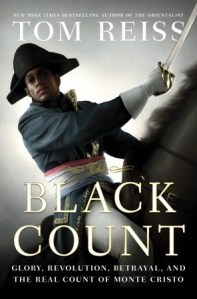
The Black Count: Glory, Revolution, Betrayal, And The Real Count of Monte Cristo by Tom Reiss Crown Publishing 2012 414 pages
The Chateau d’If, where Edmond Dantes (later to become the Count of Monte Cristo) was imprisoned, is located on an island 1.5 km outside the ancient city of Marseilles in the Mediterranean Sea. Whereas Edmond escaped the prison and lived a rich life, Thomas Alexandre Dumas, the father of Alexandre the novelist and author of The Count of Monte Cristo and The Three Musketeers, didn’t experience the same good fortune except he became immortalised in his son’s books.
The popular swash-buckling novel The Three Musketeers captured the imaginations of children around the world and lead to popular movies. Nonetheless, the gallantry and the swordsmanship of the storied heroes were fiction, or so we thought. In fact, the Musketeers were modelled on Alexandre Dumas’s own father, Alex Davy de la Pailleterie (yes, an aristocrat and one who managed to escape the guilletine) aka Dumas.
Born a slave to his aristocratic French father Antoine Davy, the Marquis de la Pailleterie and his coloured slave mother, Marie-Cossette, Alex was reared in Saint Domingue (now known as Haiti) where his father had gone west to seek his fortune at the heart of the sugar trade. After 10 years sponging off his successful sugar plantation owner brother, and one step ahead of the law, Antoine fled to Jeremie in the highlands of Haiti and location of coffee plantations, the source of his meagre income.
His parents, although unmarried lived common-law for almost two decades until her death. Following her death, Alex’s father, a ne’er-do-well, decided to return to France, selling three of his children to raise his passage and pawning Alex (born Thomas Alexandre.) In essence, he sold Alex into slavery too but made arrangements whereby he could buy him back, which he did.
Alex, a mixed race child, was on his way to France. Having conned money out of his deceased parents’ estate, Antoine took Alex to Paris to give him the aristocratic upbringing commensurate with his station. In that time period, mixed race individuals (called Americans) were considered rare beauties/novelties so Alex didn’t experience as much racism as mixed race individuals did in later years.
Alex excelled at fencing taught by Joseph Boulogne, Chevalier de Saint Georges himself mixed race and a multi-talented dancer, composer and France’s premier fencer. At 6’1″ and described as being like a centaur, Alex was a commanding presence. In addition to being a superior swordsman, Alex was known for his physical strength. A legend reported that while in riding school, standing up in his horse stirrups and grabbing hold of a beam, Alex lifted himself and his horse off the ground.
During the French Revolution, Alex joined the Sixth Dragoons where he distinguished himself. Called to Villers Cotterets in Picardy, to protect the Foret de Retz, a royal hunting forest, Alex met and became smitten with the tavern owner’s daughter. Her father gave him leave to marry his daughter provided when he returned from war, he would have attained the rank of sargeant. When Alex did return, he was a General.
General Alex Dumas lead many of Napoleon’s campaigns including one in Egypt where, upon riding into town with Napoleon, Egyptians believed him to be the conqueror, so commanding was his presence, like a centaur. Dumas was renowned for his campaign in Austria crossing the Alps in winter and single-handedly capturing a battalion.
Despite his loyalty to Napoleon, Alex was thrown into the Chateau d’If prison never being apprised of the reason. Following his trials and tribulations in war and in prison, Dumas returned to Villers Cotterets and settled into a happy family life. Enthralled by his father’s life stories, his son Alexandre Dumas grew up to memorialize him through his books, The Count of Monte Cristo and The Three Musketeers.
Buy it now!
Reviewed February 9, 2020.
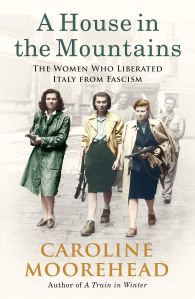
A House in the Mountains by Caroline Moorehead Chatto & Windus November 2019 416 pages
Italians were fighting two wars simultaneously during WWII: they were fighting first in the Axis then with the Allies in the global conflict while also fighting a civil war of anti-fascists against fascists. Set against the backdrop of the larger global conflict, Caroline Moorehead recounts the stories of four female anti-fascist resistance fighters — Ada Gobetti, Bianca Guidetta Serra, Silvia Pons and Frida Malan — and their friends and families as they fought both the fascists and Germans.
By the time the Italians proclaimed war against Germany and the Axis powers, Mussolini, creator and leader of the Fascist party, had held power for over 20 years and had re-shaped Italy society. Mothers have always held a revered place in Italian culture but Mussolini created a society in which women were relegated solely to motherhood no matter how educated or intelligent. Only during the war, when Italian men were fighting or were sent to Germany as little more than slave labour, did the Fascists permit women to work outside the home, for example, in factories.
Most of these factories were in the north of Italy, in Piedmont — in Turin (home of Fiat and Lancia cars and ) and Milan. Responsible for feeding their families while their spouses were at war, the women labouring in these factories began to feel empowered and became involved in the resistance movement based in Turin and the mountains outside the city.
Silvia, a doctor, treated resistance fighters whereas Ada was a leader and organizer (who brought the various resistance groups together to create one fighting force) who later played a role in Italy’s reconstruction post-war.
Moorehead chronicles the northern resistance’s constant imperilment during their harrowing war against both the Germans and Fascists (acting on their own and for the Nazis) who, in reprisal for successful resistance operations, in one instance, murdered 900 men, women and children.
Moorehead excels at recounting stories about heroines against the backdrop of the Second World War in an interesting and concise manner without becoming overwhelmed by the details.
An engrossing read, best to borrow it from the library.
Reviewed February 11, 2020.

D-Day Girls by Sarah Rose Crown Publishing April 2019 400 pages
“Ici Londres! Les Francais parlent aux Francais!” so began De Gaulle’s broadcasts on BBC to the French during WWII. At the end of each broadcast, personal messages to resistance networks and British SOE (Special Operations Executive) agents/spies were sent. Amongst the resistant(e)s were former soldiers, priests, teachers, museum workers, nuns, and the young women Andree Borrel, Lise de Baissac, Odette Sansom and Yvonne Rudellat.
While Sarah Rose’s D- Day Girls focuses on these brave resistant(e)s including Andree, Lise, Odette and Yvonne who all engaged in sabotage, gathering intelligence, forging documents and blowing up telephone and power lines despite being in constant danger, she recounts the work of the broader resistance. Many French anti-Nazi priests and nuns roamed “the countryside seeking Jewish orphans, hiding them non abbeys, enrolling them in schools, finding foster families, providing food and funds. Others faked baptismal certificates, giving Jews new identities.” She recounts the activities of Father Jean Fleury who went daily, with a rabbi, to a detention camp near Poitiers 200 times, liberating children. When the rabbi was arrested, the priest became the advisor to the Jewish community.
Engaging and easy to read, best to borrow it from the library.
Reviewed February 11, 2020.
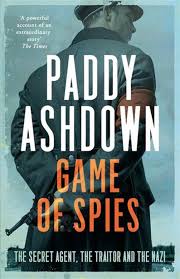
Game of Spies The Secret Agent, The Traitor and the Nazi by Paddy Ashdown William Collins Books 2017 376 pages
Despite movies that romanticise the French resistance during WWII, it was a time of great peril for French people who joined networks of resistant(e)s (resisters) and for agents of the British spy agency the SOE (Special Operations Executive) assisting the French resistance, for it was hard to discern those who could be trusted and those who couldn’t, with extremely dangerous consequences in the case of the latter.
Thousands of resistance fighters experienced successes and sacrifices in World War II France. Ashdown wisely decides to chronicle the lives of two — Andre Grandclement and Roger Landes — and the Nazi officer who sought to destroy their resistance networks. Roger Landes — the Secret Agent — Parisian born but living in England at the outbreak of the war, parachuted into Bordeaux to establish a resistance network. Son of a naval officer recognized as a Chevalier de la Legion d’Honneur, Andre Grandclement became a traitor collaborating with Friedrich Dohse, a German who loved anything French.
The book details the harrowing life of Roger Landes, first parachuted into France as a radio operator for the Scientist network. Extremely cautious by nature, Roger never slept in the same place more than two consecutive nights and interacted with very few and trusted network members. His caution saved his life for, try as he might, Dohse, an intelligence officer with the Nazis couldn’t find him. With no defining features, Landes blended in perfectly thus managing to elude the Nazis even though he transmitted messages to London next door to them. In fact, during his first assignment as a radio operator for Scientist which was blown, then during his second assignment as leader of the Actor network that undertook sabotage before and after D Day, Landes was the only resistant Dohse didn’t locate.
Locating then turning resistants was Doshe’s forte. He was a psychological warrior and excelled at manipulation. His greatest success was convincing Andre Grandclement, shockingly (given his lack of leadership abilities) head of the OCM (Organisation Civile et Militaire) network to “co-operate” read collaborate with the Nazis. Not only did Grandclement truly believe that ceasing resistance activities against the Nazis and agreeing to take on the Communists with what remained of the Nazis after the war, was the best path for France but he then began recruiting other resistance fighters to collaborate.
A gripping account of three players in WWII France, Game of Spies is highly recommended. Buy it now.
Reviewed March 1, 2020.
 Bibliophilia