

Shadow Play: The Hidden Beliefs and Coded Politics of William Shakespeare by Clare Asquith
Kobo E Book Publicaffairs 2018
It was not a good time to be Catholic in Elizabethean England. Fearful of plots to overthrown Elizabeth, she of the “reformed religion”, Catholics were perceived as traitors. All manner of persecution could be visited upon them. Yet, William Shakespeare thrived. Widely assumed that he was an adherent to the “new religion”, Clare Asquith offers compelling evidence that Shakespeare was, in fact, a Catholic and that he embedded coded messages in his plays expressing his fears for the country’s political and spiritual life.
Supported by dissident Catholic aristocrats and, like composer William Byrd, protected by Queen Elizabeth, Shakespeare thrived. Asquith analyses Shakespeare’s works, making a convincing case for her assertions.
A totally engrossing, provocative read, this book is highly recommended.
Add to your library.
The Vanishing Velazquez by Laura Cumming 
Scribner 2016 296 pages
Who doesn’t fantasize of finding a valuable worth a small fortune in one’s attic or of attending an estate sale or an auction and bringing home a treasure? John Snare, a bookseller from the town of Reading enjoyed such an experience. Under the patina of centuries of dirt, John Snare discovered the portrait of King Charles I, painted by Diego Velazquez, one of Spain’s great masters, while the King was in Spain looking to win the hand of the Spanish princess.
Once cleaned, Snare organized an exhibit of the painting in Reading which was such a success that he organized another in Edinburgh. While bringing Snare prestige and joy it seems to have brought him nothing but problems and hardship. In England, he was mocked and the providence of the painting challenged. In Edinburgh, nobles seized the painting from its exhibition and sued John Snare. The noble bullying forced him into bankruptcy and his profitable business was lost to him. More importantly, so was his wife and four children. And then John Snare disappeared.
Alternating with John Snare’s story, author Laura Cumming, recounts the life story of Velazquez and provides commentary on his paintings.
Truly interesting, this book is well worth reading.
Reviewed December 22, 2019.

Beethoven’s Hair by Russell Martin Broadway Books 2000 276 pages
“Keep your eyes on that one. Someday he’ll give the world plenty to talk about,” Mozart declared of Beethoven.
The world is still talking about Beethoven 250 years after his birth in 1770 for, despite the onset of deafness in his 20s, he was a prolific composer whose works continue to be the staple of orchestras the world over.
But the world was talking about Beethoven for a different reason in 1994 for it was then that Ira Brilliant, an Arizona real estate developer and Dr. Alfredo Guevara, aka “Che” a medical doctor, purchased a lock of Beethoven’s hair clipped from his wild greying mane minutes after his death, March 27, 1827.
Learning of his old friend’s failing health, music composition teacher Johann Nepomuk Hummel and one of his most talented students, Ferdinand Hiller, visited Beethoven several times before his death. What a thrill it was for Hiller to visit Beethoven, his idol. When he died, as was a custom in that time, Hiller clipped some hair from Beethoven’s head and encased it in a small oval wooden black framed locket.
The locket followed Hiller to Paris where he befriended fellow Beethoven enthusiasts –Berlioz, Liszt, Mendelssohn and Chopin — and to Dresden, Leipzig, Frankfurt, Weimar, Milan, Rome, Florence, Dusseldorf where he pursued permanent music positions, finally securing the post as Kapellmeister in Cologne, Germany.
Director of the Cologne Conservatory for 34 years, Hiller, not only a composer but a well-regarded music critic, gave the locket to his son Paul, an opera singer, in 1885 for his 30th birthday.
Beethoven’s Hair by Russell Martin follows the locket through history from Hiller’s decision to take a souvenir of Beethoven’s hair to the purchase of that hair in 1994 and significantly, the role of that hair in determining how Beethoven died and how he lost his hearing.
Prized by the Hiller family, Martin unravels the mystery of how the locket turned up in a sleepy Danish coastal village Gilleleje during WWII where it remained until the adopted daughter of the Danish doctor to whom it was given by a Jewish refugee fleeing Denmark, listed it for sale with Sotheby’s Auction House.
Martin’s story ends with the revelations gleaned from Beethoven’s hair concerning how Beethoven, often disheveled looking but imbued with musical passion became deaf and how he died. You’ll have to read the book to find out.
For a lover of mysteries, Beethoven’s Hair is an engaging read. For a classical music lover, this book is essential reading and essential to your music library.
Reviewed January 11, 2020.
NOTE: 2020 marks 250 years since Beethoven’s birth (thought to be either December 15 or 16, 1770) and Germany is celebrating with thousands of concerts and historical events in Vienna (the city in which Beethoven lived much of his life) and in Bonn (the city in which Beethoven was born.)
Beethoven’s hair in the storied locket resides at the Beethoven Center at San Jose University in San Jose, California. The Center includes artifacts collected by Ira Brilliant, a lover of the music of Beethoven and of the man who conquered pain and suffering to compose sublime music.
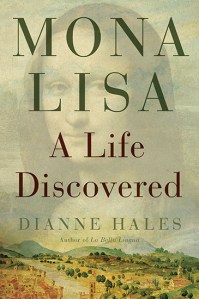
Mona Lisa A Life Discovered by Dianne Hales Simon & Shuster August 18, 2015 336 pages
Immortalized in the Mona Lisa by Leonardo da Vinci, perhaps the world’s most famous painting, Lisa Gherardini was a wife and mother from Florence, Italy. Dianne Hales explores the history of Lisa and her family as they thrived and survived the triumphs and travails of Florence. Amongst her ancestors were men who were exiled from Florence for their involvement in a coup d’etat as well as a wife of a rich cloth merchant. Lisa herself was a mother of five children.
While describing Lisa and her family’s life in the context of Florentine history, Hales also illuminates the lives of women during this period as well as the life of Leonardo.
An engaging book, Mona Lisa is a captivating read. To buy or not to buy.
Reviewed April 15, 2020.
A
 Bibliophilia