
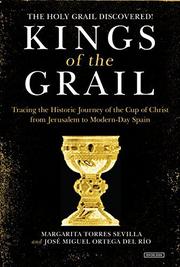
Kings of the Grail by Margarita Torres Sevilla & Jose Miguel Ortega Del Rio
The Overlook Press New York, New York 256 pages
La Morte d’Arthur, Excalibur, Sword in the Stone… the Grail stories have captivated our imaginations for centuries. Is it even real? Would our fascination end if it was finally revealed where the Grail is located?
Was the Grail even real? Yes, as convincingly demonstrated by the authors. Is the Grail still existent. Yes. Using primary evidence (original documents) in the Egyptian University of Al -Azhar, the authors follow the Grail through the centuries to discover it’s current location. Documents written by a Muslim biographer reveal the circumstances under which the Grail was transported from the Holy Land to another country.
Following the death of Jesus Christ, the Grail was venerated, under guard by the Rumis — as Muslims called Romans — at the church of the Holy Sepulchre (the church built on the site of Jesus’s birthplace.) Then, in 449 CE, Imam al-Mustansir of Egypt, gifted the Grail to the king of Denia, Ali bnu Muyahid ad-Danii, who had sent Egypt food during it’s great famine of 477 CE. ad-Danii, in turn, wanted to give it to another king to strengthen their alliance.
And so, in 479, it left the Holy Land to take up residence in… where it resides in a cathedral.
You didn’t really think I’d reveal the location of The Cup, did you?
High praise. Add to your library.
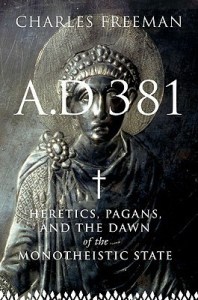
A.D. 381 by Charles Freeman
The Overlook Press 2009 252 pages
For readers interested in the early Christian church and its theology, A.D. 381 is an educational and provocative read. Fundamental to Christianity are the beliefs in the death and resurrection of Christ as well as the belief in the Holy Trinity, the belief which, when first promulgated caused dissension in the early Church and rioting in early Christian communities. Given the general lack of indifference to religion in many parts of the world, one can’t imagine such a reaction to religious creed today.
Recounting the lively and intellectual debate amongst Church fathers in 381 A.D. concerning the nature of God, Jesus and the Holy Spirit, Freeman masterfully describes the different positions of the various early Christian churches — Roman (churches located in the western Roman Empire and Antiochian (churches located in the Middle East and in Greece) and Coptic (churches located in Egypt) on the question of the relationship between God and Jesus and their relationship to the Holy Spirit. Shocking in the determination of the nature of Jesus was the role of Theodosius, the emperor of the eastern Roman empire. Frustrated and impatient with the seemingly endless discussion amongst the Christian church leaders, Theodosius issued ultimatums that would be instrumental in defining the relationship between God and Jesus becoming the Nicene Creed.
Succinct and comprehensible, Freeman also writes of the early Christian church and how the various Christian communities developed their religious practices as well as how the early Church decided upon which religious texts constituted the Bible.
An intelligent writer, Freeman expertly conveys a wealth of early Church history in an easily understandable style while maintaining the reader’s engagement.
An absorbing read and one that should be added to your library.
Reviewed December 3, 201.9
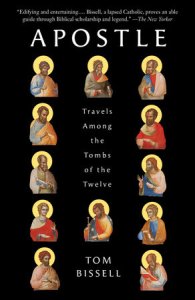
Apostle by Tim Bissell Pantheon Books 2016 407 pages
Very little is known about the Apostles and following Pentecost Sunday. The Gospels note that they “spread the Good News.” In a book that is part travelogue, Tim Bissell embarked on a three year quest to learn about the lives of the Apostles, visiting the countries to which they travelled and lived while evangelizing. He visited the tombs of the 12 (after Judas’s betrayal, another Jesus follower became the 12th Apostle.)
Bissell starts his travels in Jerusalem, a city that is riven by religious discord. Exploring the history of the eternally infamous Judas Iscariot (whose surname is derived from the village he came from), he attempts to find Hakeldema, the “field of blood” in which Judas died. On the trail of the apostle St. Bartholmew — who he surmises is Nathanael bar Tolmai described as a farmer or descendant of Egyptian royalty — he journeys to Rome although legend has it that St. Bartholmew went to India and to Armenia, the latter country of which he’s the patron saint. Remaining in Rome, he visits the Church of the Holy Apostles containing the tombs of Saints Philip and James. Of St. Philip, it’s known that he was a Greek speaking married man and father and that he may have been the first Apostle to baptize a Gentile. Was the St. James in Rome Jesus’s brother? Still in Rome, with Vatican archaelogist Pietro Zander, Bissell searches for St. Peter’s tomb in the vast necropolis and sifts through the various legends of how he died.
The most well-travelled relics of the Apostles, St. Andrew’s are entombed in Patras, Greece. Guided by Orthodox priest Father Spiridon, Bissell investigates the life of St. Andrew.
Next, Bissell journeys to Turkey in search of St. John whose body, it was reported, disappeared from his tomb. Bissell finds that St.John is buried beneath the altar at the Basilica in Ayasoluk, Turkey. At his crucifixion, Jesus asked his “Beloved Disciple” to care for his mother, Mary. In Western Christian tradition, Mary ascends into heaven while in Eastern Christian tradition, Mary moved to Ephesus and lived with St. John before her Ascension. The home they lived in is now a museum.
On the trail of doubting St. Thomas, Bissell travels to Chennai, India in Kerala province where he founded the Christian church which, within 300 years Roman Christianity worked its way into the upper echelons of Indian society. St. Thomas has always been an engima as in the Gospels he was referred to as Thomas didymus, meaning “the twin”. Jesus’s twin? Bissell delves into the various theories about St. Thomas’s family background.
A UNESCO World Heritage Site, Saint Sernin’s Basilica in Toulouse, houses the relics of Saints Simon (the Canaanite ) and Thaddeus. Both apostles, lesser known than the other apostles, are rather obscure. Considering many theories as to their identities, Bissell wonders whether Simon and Thaddeus are brothers of Jesus. He expounds at some length about the esteemed role of Jesus’s family in early Jewish Christianity until the proselytization of Jesus’s teachings was so successful in pagan lands that Christianity became a Gentile religion.
Bissell ends his travels in Kyrgyzstan, looking for the tomb of St. Matthew.
Whatever one’s religious beliefs, Bissell’s interactions with residents of the countries he visits are very interesting and entertaining as are the descriptions of the countries.
An engrossing read, it’s an excellent addition to your library.
Reviewed January 8, 2020.
 Bibliophilia