
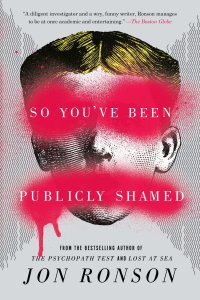
 So You’ve Been Publicly Shamed by Jon Ronson Riverhead Books New York, NY 2015 290 pages
Avoiding, rejecting, repudiating, shunning, publicly shaming and ostracizing have been part of most human cultures as long as humans have been organized into communities. Indeed, humans have rejected, shamed, ostracized and even executed people who the majority feel act outside the norm. Think wise women learned in natural medicinal cures condemned as witches.
Wearing one’s shame like a scarlet letter, being pilloried in the public square for community members to jeer and denigrate, individuals publicly shamed centuries ago experienced an end to their suffering. Not so today with social media where the slightest of transgressions can lead to world wide and everlasting condemnation for which, there seems, little escape.
So You’ve Been Publicly Shamed relates the stories of several individuals who experienced shaming disproportionate to their poorly worded jokes, misinterpreted jokes or minor mistakes. Hounded, for many, their lives were destroyed. Jon Ronson explores the motivation for public shaming. Is it emotional contagion? Is it schadenfreude (the glee in seeing others fail)? And why do some behaviours elicit outrage while others, far more distasteful, garner little response? Does that fact that so much shaming these days occur via social media, “… that when shamings are delivered like remotely administered drone strikes nobody needs to think about how ferocious our collective power might be.”
Perhaps one of the most interesting chapters in Ronson’s book concerns the studies undertaken by psychiatrist James Gilligan of inmates in Massachusetts’ mental health institutions and prisons. At the root of violent behaviour, found Dr. Gilligan was deep shame and mortification. Ironic that the justice system dehumanizes people caught in it be shaming them, Ronson learned.
As American Founding Father Benjamin Rush penned in 1787, “Ignominy is universally acknowledged to be worse punishment than death… It would seem strange that ignominy should ever have been adopted as a milder punishment than death, did we not know that the human mind seldom arrives at truth up on any subject till it has first reached the extremity of error.”
Definitely read. Borrow from the library.
 The Orchid and the Dandelion by W. Thomas Boyce, M.D. Allen Lane 2019 277 pages
I’ve often wondered how children being reared in the same family by the same parents in the same environment can develop so differently. Dr. Boyce offers an intriguing explanation. Yesteryear, one may have called it temperament; Dr. Boyce makes a compelling case for temperament and convincingly explains a link between temperament and health outcomes (epigenetics: the interplay between genes and environment.) For example, research has demonstrated that while all children experience illnesses (colds, flu etc.) a small subset of children are frequently ill and that this subset are composed of those children who have serious health issues.) It appears that sensitive children (“Orchids”) who find it harder to adapt to change also more frequently convert emotional distress to physical illnesses.
Employing a poetic flower metaphor, Dr. Boyce describes “Orchids” — sensitive children who thrive and go on to achieve great success if raised in safe, structured environments characterized by care and support — and “Dandelions” who are hardier and who can thrive in any condition, healthy and even, unhealthy.
Dr. Boyce discusses the role of genetics and environment in the development of sensitive children (“Orchids”) and in more adaptable children (“Dandelions.”) Citing numerous interesting scientific studies, Dr. Boyce offers insight into personality formation and how to parent “Orchids” and “Dandelions” to nurture their growth and development.
A fascinating book written in highly readable prose, this book is a must read and a great addition to your library.
Reviewed April 30, 2019.
 Talking to Strangers by Malcolm Gladwell Little, Brown & Co., 2019 386 pages
How is it we have such a difficult time discerning the truth, asks the author. Using a number of case studies, Malcolm Gladwell identifies the mistakes we make when taking the measure of one another. Oftentimes, we get it so wrong! Gladwell writes of the CIA’s abject failure to realize almost every one of it’s Cuban spies were double agents who had been hand-picked by Fidel Castro himself, to “work” for the Americans!
How did Hitler manage to delude British Prime Minister Neville Chamberlain into believing he could be reasoned with? Many British cabinet ministers believed Hitler didn’t really want to go to war and was open to negotiating peace. We all know how that turned out. From the beginning, Winston Churchill and Anthony Eden, former Foreign Secretary, saw Hitler for who he was: “a duplicitous thug.” As Gladwell observes, Chamberlain and the Cabinet Ministers who spent the most time with Hitler were conned by him while those Cabinet Ministers who knew the least about him, were more accurate in their assessment of him.
Through the examination of occupations that, in life and death situations, require a quick but definitive assessment of the character of others (bail judges and intelligence agents) and through an analysis of criminal cases lately in the media (Bernie Madoff, Amanda Knox, Brock Turner, Jerry Sandusky), Gladwell describes how, in the absence of intimate knowledge of others, we make decisions about them.
It turns out we are easily deceived by others for a number of reasons such as the theories of Truth-Default, Transparency, Matching and Myopia amongst others.
Engaging in style, featuring interesting case studies to illustrate the difficulties we have in accurately assessing others, Gladwell writes about psychological concepts in an accessible manner such that it was hard to put the book down.
A must read and an excellent investment for your library.
Reviewed December 16, 2019
The Great Pretender by Susannah Cahalan Grand Central Publishing 2019 382 pages
Given the stigma still in 2019 ! associated with mental health, I can only imagine how horrendous it must’ve been living with a mental health issue in the mid 20th century. Individuals with issues as prevalent as depression and anxiety were treated abominably, oftentimes locked in mental health facilities then named “insane asylums” most of which were archaic in conditions and treatment.
The zeitgeist of the 1960s and 1970s was to question everything as racism and discrimination were being confronted and as the Vietnam war was raging. People were questioning the concept of madness and the efficacy of psychiatry. Sanity was being questioned, made easier by achieving a different consciousness associated with growing use of psychedelic drugs.
Into this environment, at the start of his career in psychology, Dr. David Rosenhan taught an abnormal psychology class during which some of his students insisted that in order to help people with mental health issues they needed to experience it. The seed thus planted, in 1973, Dr. Rosenhan devised an experiment whereby eight sane people — Dr. Rosenhan himself, students, an artist, a pedetrician and psychologists — committed themselves to a number of mental health hospitals in various American cities, able to leave only when they had proven their sanity.
Using just three words — empty, hollow, thud — to describe how they felt, all eight were deemed to be mentally ill and admitted. All but one of these eight people were diagnosed with schizophrenia. Despite demonstrating their sanity within days of their admission to hospitals, they were discharged anywhere from over two weeks to almost two months.
The results of this study, On Being Sane in Insane Places, written by Dr. Rosenhan, and published in Science magazine in 1973, was groundbreaking, shaking the field of psychiatry to its foundations and eventually leading to its overhaul. Significant in this was the adoption of a more scientific method of developing the bible of psychiatry, the Diagnostic Statistical Manual (DSM) used today to determine mental health diagnoses.
The Great Pretender is an absorbing read, part brief history of psychiatry, part story of the study of eight pseudo-patients and their hospital experiences and part detective story. In researching the study which was the impetus for positive changes to the field of psychiatry, Susannah Cahalan discovered a mystery (oxymoron intended): who were the pseudo-patients and what had happened to them?
A must read.
Stats
46.6 million American adults (18.9% of Americans) were diagnosed in 2017 and 5.3 million Canadian adults (14.3% of Canadians) reported needing help with mental health in 2018.
Common diagnoses are clinical depression (the loss of hope) and anxiety disorders. Cognitive Behavioural Therapy (CBT) is an effective treatment modality for depression and anxiety.
If in need crisis, in Canada: Kids Help Phone 1.800.668. 6868 for children and teens. Adults call local help lines. Help Lines can refer callers to local psychotherapists.
Reviewed December 17, 2019
 Twilight of the Elites by Christophe Guilluy Yale University Press 2019 177 pages
While describing the fundamental economic, societal and political changes being wrought in France as a result of globalization, Christophe Guilluy’s book reflects the current experience of most Western nations.
Globalization has cost many French workers (and workers in other Western nations) their jobs in manufacturing or industry as ever-hungry for more and more profit, corporations have moved their manufacturing plants overseas, primarily to China and other Asian countries (where far from the purchasing public’s eyes, we don’t see the sweatshops) thereby creating massive unemployment in their home countries. As long as they earned half decent wages, working class French people could (barely, but still) afford to live in Paris or France’s other large cities. Once their skilled labour jobs disappeared, working class French people could no longer afford to stay in their neighbourhoods and, in order to make ends meet, began living on the periphery of their home cities or in towns and villages within the city’s orbit from where they must commute a good long time, now to low paying jobs in the service sector. Loss of employment and homes resulted in a concomittant loss of power and status to affect the political system. As the working class French were displaced from their jobs then their homes, the “bobos” (bohemian bourgeoisie) bought their homes and gentrified their neighbourhoods such that the working class can no longer afford to live in their neighbourhoods. Bobos (middle class) and the wealthy, having done exceedingly well by globalization, in their own self-interest, are not concerned about creating a just society in which everyone has equal access to society’s resources so, the working class continues to live a tenuous existence..
Loss of sustainable employment and loss of their homes resulted in a concommittant loss of power and status to affect political and social change. So, when the working class, living in the periphery or in rural areas, speak up about their unemployment and underemployment, lack of opportunities and barely sustainable wages, “The dominant classes evidently believe the threat to their authority is so great that they have no choice but to deploy their ultimate weapon: antifascism”, whereby instead of responding to legitimate economic concerns, the dominant classes distort economic concerns into working class bias against immigrants. If the dominant classes can turn economic concerns into racism, they need not address the economic issues.
Attempting to maintain what they have, people of moderate or little income choose to live in communities where they give and receive support, often from others in like circumstances. To maintain what little economic power and resources they do possess, people of moderate or little economic means tend to vote for the political party National Front which advocates for restrictions to globalization so as to protect jobs. However, to maintain economic and political control, the party is attacked as racist by the economic and political elites thereby deflecting from the causes of the marginalization of people of modest means.
Given the current strikes in France, this book is timely, not only for citizens of France but for all western countries.
Highly recommended and worth adding to your library.
December 28, 2019.
Had It Coming by Robyn Doolittle 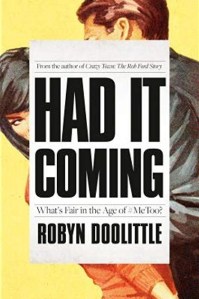
Allen Lane 2019 292 pages
Over the course of more than a year and a half, the author, Robyn Doolittle, investigated how police in Canada addressed sexual assault cases and discovered that, “… collectively, Canadian law enforcement was disproportionately dismissing sexual assault complaints as “unfounded”… the term means that they think the incident didn’t happen. And 19.39 percent of sexual assault allegations were being discarded in this way.” Doolittle further learned that only 34 percent of sexual assault cases ended with a criminal charge.
Interviews with more than 100 experts — within the legal system and within the medical system — and a review of many cases revealed a disturbing pattern: ” … files were closed with no investigation …” and police didn’t follow routine investigative steps such as “collecting video surveillance, interviewing witnesses, gathering forensic evidence, questioning the suspect.”
More alarming was the fact that sometimes women reporting sexual assault waited months before being interviewed by the police and that the police outright accused some women reporting sexual assault of lying. Some police lectured complainants about drinking too much alcohol and some were “challenged about why they hadn’t fought back more or called for help.”
Doolittle chronicles the history of laws regarding sexual assault and the attitudes in the past that contributed to “rape culture”. Reviewing highly publicized cases such as that of Kobe Bryant, Jian Ghomeshi, Brock Turner and other sexual assault cases that occurred on university campuses, Doolittle examines the issues of consent and how women are perceived.
Crucial to how a woman is impacted by sexual assault is an understanding of how trauma changes the brain; Doolittle conveys this information in an easy to understand manner. She raises important questions about the lack of training in sexual assault that Canadian judges receive and the fact that judges can’t be instructed that they must take such training (lest this impact their judicial independence.) In this reader’s mind it’s the equivalent of not requiring a surgeon to take courses in the specific kinds of surgery s/he is expected to do. How can wilfull ignorance ever result in justice?
An excellent, thought-provoking book which belongs on your reading list.
Reviewed January 13, 2020.
 Catch and Kill by Ronan Farrow Little, Brown and Company 2019 464 pages
The expression “six degrees of separation” refers to the phenomenon that people are six, or perhaps fewer, social connections from each other. It appears in the media world there’s only three degrees of separation for the inter-relatedness of Harvey Weinstein and his company, Miramax, with NBC’s parent company, made it possible to thwart Ronan Farrow and his producer Rick McHugh from reporting on Weinstein. More than a year before the story “broke” Farrow and McHugh had amassed many witness statements from women who had been sexually assaulted or raped as well as audio recordings of Weinstein admitting to having raped a witness yet the bosses at NBC and the parent company repeatedly informed him he didn’t have enough information. They had the story but refused to broadcast it, which in media parlance means “catch and kill.” In other words, catch the story but kill it instead of reporting it. Finally, Farrow took his story to the New Yorker magazine which printed it.
Written in first person, Ronan reports the numerous obstacles he and McHugh faced in trying to air the story. In an attempt to “kill” the story, his own bosses accused him of bias given that his sister had accused their famous father — Woody Allen — of sexually abusing her. His bosses threatened his career as a means of dissuading him from investigating Weinstein.
The book reveals how men with power and influence are protected by each other. Quelle surprise. What is surprising is the ability of men in power to totally jettison their morals (perhaps they have none), to justify the protection for business reasons or, in light of the damning evidence, to refuse to contemplate that the assault occurred.
Shortly before reading the book, this reviewer watched the television series The Morning Show which, it appears to be loosely based on some of the information from the book.
At the time of writing, Weinstein’s trial has just begun with hair-raising testimony provided by three women. The book provides excellent context in describing how the numerous reports of assaults and rapes — of which Hollywood was well aware — finally lead to an investigation.
An engaging writer, Farrow immerses the reader in the investigation and the roadblocks continually being erected but, most importantly, he sensitively reveals the impacts (the emotional, social and career) of the sexual assaults and rapes on the lives of the women Weinstein preyed upon.
Definitely read this book and consider buying if for no other reason than as a reminder that absolute power (in this book to make or break a career and a livelihood) corrupts absolutely (contributing to the silence of the many men who were aware and did nothing and the many people who were aware and who destroyed careers.)
Reviewed January 28, 2020.
 Bibliophilia