

Zoroaster’s Children by Marius Kociejowski
Biblioasis 2015 Windsor, Ontario 167 pages
“… I think it has become incumbent upon authors to write not so much about getting to a place as in being able to write out of it.” This, Marius Kociejowski ably accomplishes in his travels over the years to Syria, Greece, Iran, Estonia, Tunisia, Russia, and the Czech Republic.
Through the relationships Kociejowski develops with people he meets in his travels, the reader gets an authentic sense of place.
From visiting the ruins of the monastery complex of Saint Simeon, near Aleppo, where the ascetic Saint Simeon Stylites stood on a pillar for 37 years, the writer chose the road less travelled, journeying to Basofan, a Yezidi village. Kind and hospitable, the Yezidi villagers welcomed him and while he hoped to learn more about their faith, they remained guarded and secretive, having done so for centuries to survive. Years later, he would wonder about the safety and whereabouts of the Yezidi girls he met.
Meeting with a calligrapher in Aleppo, the writer understands the calligrapher’s commitment to the art form as the “expression of a state of mind.” His interaction with an old woman in Greece, who gave him an apple, made more of an impression on him than did the Parthenon as did his visit to the Gardens of Kolymberta in Alia, a village in the interior of Sicily where a “splendid feast”, the hostess’s father playing the guitar and singing was a transformative experience.
Oppressive rule in Iran makes it impossible to truly know Iranians but Kociejowski’s friendship with Farhad furnishes the reader with a glimpse of the reality of life in this country. Despite the government’s anti-Western theocracy, through his book collection of English books — few but treasured paperbacks of which he was most proud — Farhad demonstrated a desire to form relationships with Westerners. Living in a repressive regime has taken its toll on Iranians as described by Farhad, ” The river is empty… and so too is the soul of this country… Even love is hidden behind a curtain.”
Most poignant, perhaps, is Kociejowski’s description of Lubyanka Prison in Moscow, headquarters of the FSB (secret police) and notorious prison, where Kociejowski’s father had been imprisoned.
Well worth the read. To buy or not to buy…
Full Moon over Noah’s Ark  by Rick Antonson
Skyhorse Publishing 2016 382 pages
Capturing the imaginations of people worldwide is the religious story of Noah’s Ark, a boat filled with two of each animal species, as well as Noah’s family, to repopulate the earth after the Great Flood. But the Jewish Torah and Christian Bible story are not the first about a catastrophic flood that lead to the building of the Ark. As Canadian travel writer Rick Antonson travels to Iraq, Iran and Armenia and to Turkey, to climb the 17,000 foot Mount Ararat, he learns of the long history of the Flood story (when the rising waters of the Mediterranean Sea caused flooding of the Black Sea) which was first recorded in the Flood tablet in the Epic of Gilgamesh in 2000 to 1800 BCE to be followed circa 1900 -1700 BCE by the Ark Tablet which formed the basis of the Babylonian flood story. Some thousand years later, circa 538 -332, the story of Noah’s Ark featured in the Torah and Bible’s Genesis chapter.
As he travels through the region where Noah’s Ark is purported to have landed, Antonson meets many generous and helpful individuals who share their region’s history and politics with him and share information about the Flood Story. A highlight to this lesser-travelled area of the world is his trek to the summit of Mount Ararat with five other climbers from around the world.
A thoroughly engaging, well-written travel and history story.
Well worth the read. Definitely borrow from the library.
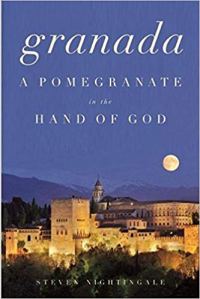
Granada A Pomegranate in the Hand of God
by Steven Nightingale
Counterpoint Press 2015 384 pages
Life began in a garden for the author, Steven Nightingale, who writes a lyrical love letter to his adopted home, the Albayzin barrio/neighbourhood of Granada and to the city, centre of Al-Andulas and a golden age of Spain, featuring religious harmony between the three Abrahamic religions: Judaism, Christianity and Islam, under Moslem rule between 711 and 1491 CE.
Weaving his present day experience living in the labyrinth of homes with magical gardens cascading down the hillside of the Albayzin, Nightingale chronicles its advancements in the arts (dance, music, literature) and science, medicine and architecture (the Alhambra), philosophy, gardening and industry, as well as acceptance of religious diversity (some 300 years ahead of the rest of Europe) and how, with the invasion of Ferdinand and Isabella, all was lost. The toll to the Jews and Moslems wrought by los reyes catolicos (the most Catholic monarchs) and to the progressive, enlightened and learned society of Al Andulas was cataclysmic. A once thriving society and country were reduced to a primitve economy and a fundamentalist religious ethos that became the foundation for Spain’s fascism.
Nightingale concisely recounts Spain’s history levened by the beauty of the Albayzin’s present day.
Entranced by Granada and it’s culture, Nightingale’s prose is lyrical and evocative, prompting this reader, captivated by the Alhambra for decades, to dream of upping sticks and making the move. The Albayzin and its carmenes (gardens of lemons, oranges, figs and pomegranates) is enchanting.
Add this one to your library.
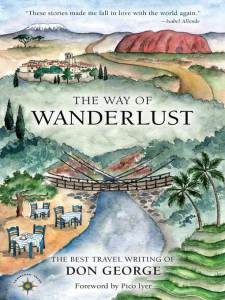
The Way of Wanderlust by Don George Travelers’ Tales 2015 276 pages
Simply the most beautifully written travel book I’ve read and amongst the best written of any genre. Every story in Don George’s anthology evoked a sense of place and was a meditation on connections between people and place and the meaning of life. The Way of Wanderlust demonstrates how profoundly life changing travel can be.
An absolute must-have addition to your library.
Reviewed January 5, 2020.
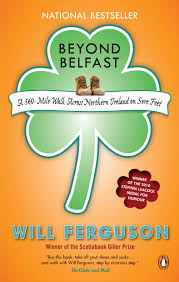
Beyond Belfast by Will Ferguson Penguin Books 2011 416 pages
Often soaked to the skin by frequent rainfalls and suffering blistered feet from walking the Ulster Way, a 560 mile trek mostly along the perimeter of Northern Ireland, Will Ferguson chronicles his discoveries of people and place. Through fields and forests, dales and villages, atop mountains and along the sea, Ferguson discovered a wild beauty punctuated by quaint villages and towns.
Checking out the pubs and surviving on soup “du jour” and a dizzying selection of potato chips, Ferguson encountered many interesting and many friendly people as he did hiking up a mountain. Passed by a number of other hikers, he was welcomed at the summit by two men. Learning he was Canadian, conversation ensued about his impressions of Northern Ireland. What had struck Ferguson in his journey were the Royal Ulster Constabulary (RUC) police stations enveloped by barbed wire and looking more like fortresses. His joke about who would choose to be a police officer in Northern Ireland (akin to being a peace keeper in a war zone) fell flat when the men informed him they were RUC officers. Despite the joke, they invited him for a drink when he arrived in Belfast; he was surprised when the bar was on the grounds of the police station.
While he doesn’t note the date of his trek, it appears it occurred before the Good Friday Accord which ended “the troubles” in Northern Ireland. Consequently, his book is somewhat of a time capsule in that throughout this trek he travelled through Catholic and Protestant towns and villages with some separated into neighbourhoods based on religion. As lovely and post-card pretty they were, some of these communities were rooted in a history of violence between the various military factions affiliated with Protestantism (The Ulster Voluntary Force and the Ulster Defense Association) and Catholicism (the IRA.)
Part travelogue and party history book (early middle ages to the religious and cultural defining of the Battle of Boyne to the “troubles”), Beyond Belfast is also part mystery for Ferguson was also attempting to learn about his family’s past. His maternal grandfather, orphaned as a child, emigrated to Canada from Belfast with little information about his extended family. The reader can feel Ferguson’s anticipation as he searches for information and this theme in the book was most engaging.
Entertaining and well-written, the only addition to the book would’ve been the inclusion of photographs to add to the sense of place Ferguson so well described.
Well worth reading.
Reviewed February 12, 2020.

Paris to the Pyrenees by David Downie Pegasus Books 2013 317 pages
The world over, pilgrims flock to France to begin their pilgrimage to El Camino de Santiago de Compostela/le Chemin de Saint Jacques de Compostelle commonly known as The Way.
Writer and custom walking tour operator David Downie and his photographer wife Alison Harris, on foot, embarked on their own pilgrimage through France with the first leg of their pilgrimage through Burgundy, renowned for its’ wines. Verdant but isolated, this area of France is rich in ancient history. The ancient Aedui were a Gallic tribe and “friends of Rome” who called upon Julius Caesar to assist them in resisting the invasion of Celtic and Germanic tribes. Caesar’s intervention lead to the Gallic Wars during which Caesar met the ancient warrior Vercingetorix at Bibracte, site of an historic battle.
Burgundy is also the site of the famed monastery at Cluny, the largest monastery in Europe before much of it was dismantled, stone by stone, during the French Revolution. Still a pilgrimage site, Cluny is now renowned for Taize, a Christian monastic community to which youth from around the world travel for prayer retreats.
Following the ancient Roman road through Burgundy, David and Alison stayed at B & Bs, typically owned by French couples who decamped from Paris looking for a peaceful life. And peace is what David and Alison encountered: peace in their surroundings and a growing inner peace.
Recommended reading from the library.
Reviewed February 17, 2020.
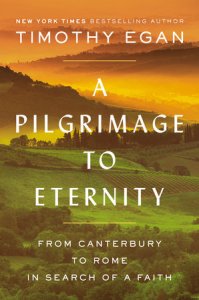
A Pilgrimage to Eternity by Timothy Egan Viking Books October 15, 2019 367 pages
Imagine following in the footsteps of pilgrims 1000 years ago! In 990 A.D. the Archbishop of Canterbury, Sisteric, travelled to Rome from Canterbury, recording his route. Since that time, pilgrims have followed Sigeric’s route along the anciet Roman Road, the Via Francigena (the Italian world pronounced frahn chi jane a) departing Canterbury Cathedral, Canterbury England and travelling through France, Switzerland and Italy to arrive in Rome.
Lesser known than the Santiago de Compostella, the author Tim Egan, encountered fewer pilgrims although the Via Francigena was a very well-travelled route through the heart of Europe, especially during the Middle Ages when, in the Jubilee Year of 1300 A.D. Pope Boniface proclaimed that anyone making the pilgrimage would have their sins forgiven. Like many pilgrims before him, Egan carried a plea in his heart. Like many present-day pilgirms, he carried doubts about the existence of God.
Passing through lovely cities, towns and villages not usually considered tourist hot-stops- among them the walled city of Laon; Reims, where French Kings were crowned; Epernay, home of champagne and of Dom Perignon, the French priest who devoted his life to grapes and God; beautiful towns near Geneva Switzerland; the walled town of Lucca in Tuscany and on to Rome and the Vatican.
Egan so well captures the welcoming spirit of the various religious communities and hosts of inns in which he stayed and the cities, towns and villages in which he passed, that the reader is hard-pressed from hopping a plane to visit them.
Commencing his pilgrimage as a questioner of faith, worried about the future of the world and the future of the Catholic Church into which he was baptised, Egan is excited by Pope Francis and hopes to have an audience with the Vicar of Christ upon his arrival in Rome. Questioning his faith in consideration of his own life experiences, the state of the church and of the world, Egan sensitively and respectfully reflects on God and arrives at an unforseen conclusion.
Part history, part spiritual memoir and part travelogue, Pilgrimage to Eternity is infused with hope and appreciation. The book is uplifting and leaves one with a sense of joy.
Reviewed February 26, 2020.
 Bibliophilia